Written test papers
A paper at the close of each module. Marked and returned with comments, not a multiple-choice box-tick.
The Diploma · Fully online
Ten modules. Five assessed case studies on real horses. A working skill you can charge for, learned entirely from home at whatever pace your life actually allows.
or 5 monthly payments of £300
What you get
The curriculum
Each module builds on the one before it. You are never asked to interpret something you have not yet been taught to see.
Where iridology began, how Syd Mercer carried it into the equine world, and how Ellen Collinson built the method you are about to learn. Scope of practice and ethics.
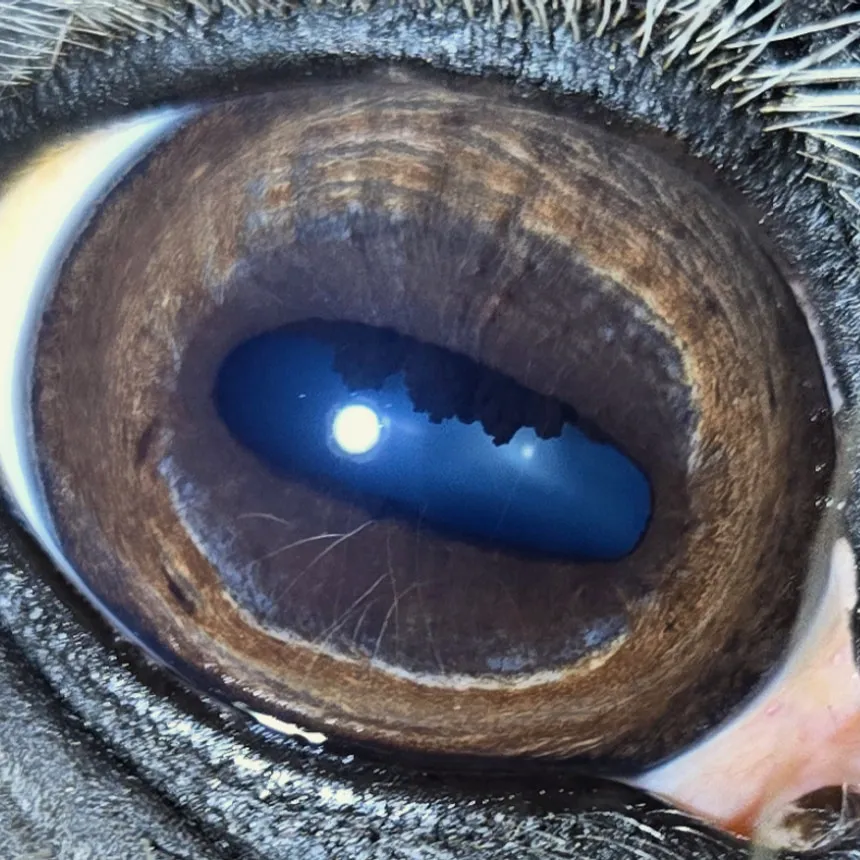
The structures you will be reading in the horse’s eye, including the corpora nigra, which has no human equivalent. What counts as normal variation, and what counts as a genuine marking.
The clock-face topography. Which zone corresponds to which organ system, how the left and right eyes differ, and how to orient yourself in any photograph.
Reading the inherited blueprint. Constitutional type, and the strengths and weaknesses a horse arrives in the world already carrying.
Reading tissue integrity from the fibres themselves, and learning to grade what you are seeing rather than simply noticing it.
Discolouration, deposits and accumulation. What the body has failed to eliminate, and where it has chosen to store it instead.
The single most common presentation in practice. Hindgut, absorption, and the liver’s reach into coat, temperament and performance.
The elimination pathways, hormonal balance, and the circulatory patterns that so often underlie chronic, vague, hard-to-place symptoms.
The practical skill that makes or breaks a practitioner. Equipment, lighting, restraint, safety, and how to get a usable image from a horse that would rather you did not.
Turning findings into a remediation plan, matching herbs to indications, and producing a report a client will actually act on.
How you're assessed
The written work matters. The five case studies matter more. They are the difference between knowing the theory and being able to sit in front of a client.
A paper at the close of each module. Marked and returned with comments, not a multiple-choice box-tick.
Real horses, photographed by you, analysed by you, written up as you would for a paying client. This is where the course is actually won.
On successful completion you receive the Ellen Collinson Diploma of Equine Iridology and go onto the school’s public register of practitioners.
Enrol
You get the full material from your first payment either way. No interest, no credit check.
One payment, done.
Spread across your first five months.
Rather talk it through first? or email Michaela at equineiridologyschool@gmail.com.
From the register
Graduates working commercially across three continents, in their own words.
Her methods for linking the iris to systemic health and herbal support have completely elevated my practice. It gave me the whole picture of the horse’s health.
Equine iridology is so beneficial for your horse’s health. A world of knowledge uncovering so much insight.
I’m an internationally certified equine iridologist. It’s been one of the most important and beneficial additions to my practice, and the knowledge of herbal remedies is incredible.
Before you enrol
No. The course starts from first principles and assumes no background in iridology, anatomy or herbalism. What genuinely helps is practical time around horses. Knowing how to handle one safely matters more here than any certificate.
There is no deadline. Most students take between six and twelve months alongside work and horses. The material stays yours indefinitely, and you set the pace entirely.
The diploma is £1,500. You can pay in full, or in five equal payments of £300 across the first five months of study. There is no interest and no credit check, and you get full access from the first payment.
On completion you receive the Ellen Collinson Diploma of Equine Iridology and are added to the school’s public register of qualified practitioners. Graduates practise commercially in the UK, Australia and Canada. We will be straight with you: equine iridology is a complementary discipline and is not statutorily regulated. We say so openly, and we teach you to work alongside vets rather than in place of them.
No. The diploma is completed entirely online, including your assessed case studies. Everything is done from home, wherever home is.
A modern smartphone is genuinely enough to begin with. Module 9 covers photography properly, including the inexpensive add-on lenses that make the job easier, but you will not be asked to buy specialist equipment to start.
No, and any practitioner who tells you otherwise should be avoided. Iridology indicates tissue weakness, constitutional tendency and areas under stress. It flags where to look. Diagnosis is veterinary work, and the course is firm on that boundary.
Course fees are not refundable once you have been given the material, because at that point you have it. That is precisely why we would rather you asked everything first. Be as sceptical as you like before you pay: email Michaela, ring her, or use the assistant on this page. Nobody here is in a hurry to take money from someone who is not sure.